As broadband demand continues to grow, network operators face a strategic question: should they expand fiber deeper into the access network, continue upgrading hybrid fiber-coaxial infrastructure, or combine both approaches?
There is no single answer for every operator. Fiber-to-the-x, commonly known as FTTx, offers long-term bandwidth potential and lower signal loss over distance. Hybrid fiber-coaxial, or HFC, remains a valuable infrastructure base for many cable operators, especially where coaxial networks are already widely deployed. The right choice depends on existing assets, service targets, deployment cost, upgrade timeline, and the type of services being delivered.
Fiber deployment is accelerating globally. In the United States, the Fiber Broadband Association reported that fiber now passes more than 60% of primary households, with nearly 100 million total FTTH passings when redundant builds are included. At the same time, HFC technology is also evolving. CableLabs describes DOCSIS 4.0 as enabling the next generation of broadband over HFC networks, supporting symmetrical multi-gigabit speeds, high reliability, strong security, and low latency.
For operators planning access network upgrades, the real question is not simply “fiber or coax.” It is how to use each architecture effectively.
Understanding FTTx
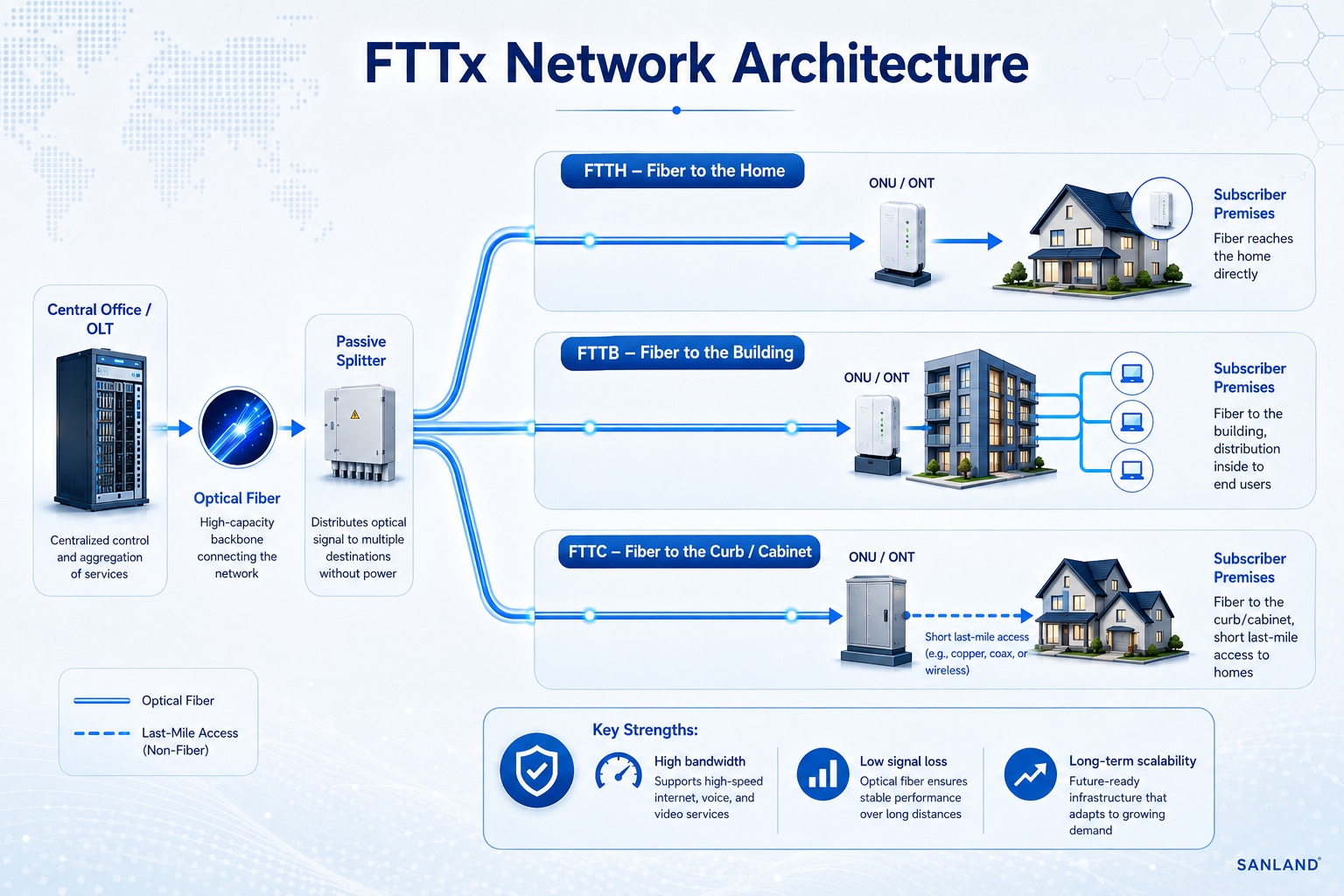
FTTx refers to a family of fiber access architectures, including FTTH, FTTB, FTTC, and other deployment models where fiber is extended closer to the subscriber. In a full fiber-to-the-home network, optical fiber reaches the customer premises directly. In other models, fiber may terminate at a building, curb, cabinet, node, or distribution point, with another medium used for the final drop.
The main strength of FTTx is capacity. Optical fiber supports high bandwidth, low attenuation, and strong scalability. Once fiber is deployed, operators can upgrade terminal equipment and optical modules over time without replacing the physical medium as frequently as legacy copper-based systems.
FTTx is especially attractive for greenfield developments, dense residential areas, enterprise campuses, and markets where long-term service differentiation depends on high upstream capacity, low latency, and future-proof infrastructure.
However, FTTx can also require significant civil work, permitting, customer premise installation, and capital investment. In areas where coaxial infrastructure already exists, a full fiber rebuild may not always be the fastest or most economical path.
For operators building optical access networks, components such as optical receivers, ONU products, and PON-compatible modules become essential. Sanland’s FTTx Solutions include product categories designed for fiber access, CATV transmission, and PON network applications.
Understanding HFC
HFC combines fiber and coaxial cable. Fiber is typically used to carry signals from the headend or hub to optical nodes, while coaxial cable distributes service from the node to homes or businesses.
For cable operators, HFC remains highly practical because much of the physical infrastructure is already in place. Instead of replacing the entire last mile, operators can upgrade amplifiers, nodes, diplex filters, optical transmitters, receivers, and customer equipment to increase capacity.
The evolution of DOCSIS has kept HFC relevant. DOCSIS 3.1 and DOCSIS 4.0 allow operators to push more bandwidth over coaxial networks. DOCSIS 4.0 is particularly important because it enables higher upstream capacity and multi-gigabit service potential over upgraded HFC networks.
HFC is often a strong choice when operators need to improve broadband performance quickly while maximizing the value of existing assets. It can be particularly suitable in mature cable markets, suburban service areas, and regions where full fiber overbuilds would require long construction cycles.
Key Factors When Choosing Between FTTx and HFC
1. Existing Infrastructure
The first consideration is what the operator already owns.
If a service provider has an extensive coaxial network with active subscribers, HFC upgrades may deliver faster returns. Replacing selected network components can increase capacity without rebuilding the entire access network.
If the operator is entering a new market, building in a new housing development, or replacing outdated copper infrastructure, FTTx may be the better long-term investment.
2. Bandwidth and Service Roadmap
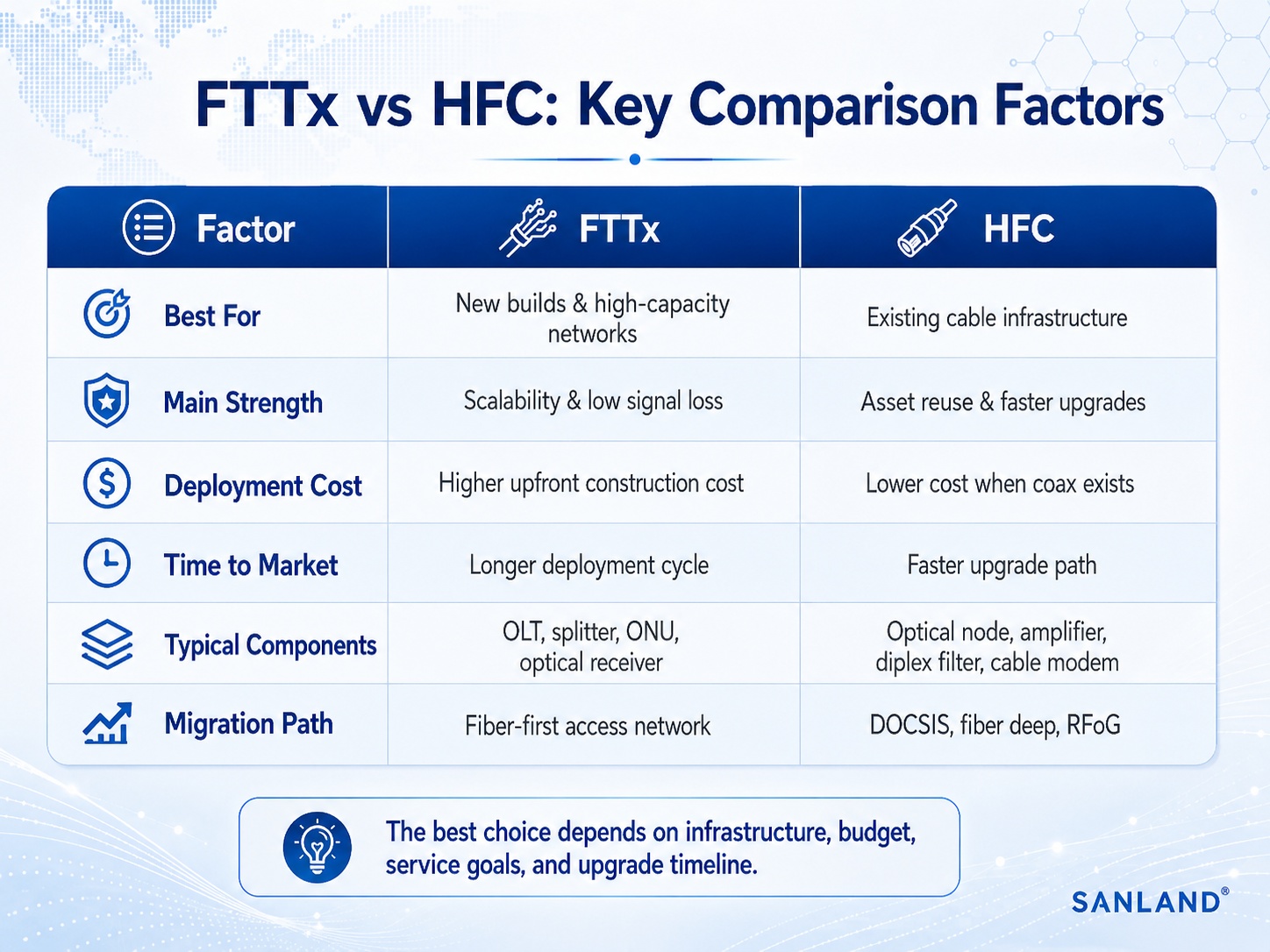
FTTx is generally preferred when the long-term goal is symmetrical high-speed broadband, enterprise-grade services, and a network designed for decades of capacity growth.
HFC remains competitive when upgraded with modern DOCSIS technology. Operators can provide gigabit and multi-gigabit broadband over coaxial networks, especially when fiber is pushed deeper and amplifier cascades are reduced.
The service roadmap matters. If the operator expects heavy upstream demand from cloud applications, remote work, video conferencing, gaming, and business services, upstream capacity should be a major factor in the decision.
3. Deployment Cost
FTTx often involves higher initial construction costs, especially where underground fiber deployment is required. Costs may include trenching, pole access, permitting, labor, home installation, optical distribution network design, and customer premise equipment.
HFC upgrades can be less disruptive if existing coaxial drops, taps, and distribution infrastructure are still usable. However, HFC is not free from cost. Operators may need to replace amplifiers, upgrade optical nodes, improve shielding, expand spectrum, and optimize the return path.
The best economic model compares not only upfront cost, but also long-term maintenance, energy consumption, upgrade cycles, customer churn, and revenue potential.
4. Time to Market
HFC upgrades can often be completed faster than full fiber overbuilds because much of the network is already deployed. This can be important when competitors are launching higher-speed packages or when operators need to respond quickly to market pressure.
FTTx deployment can take longer, but once installed, it provides a strong long-term platform. In competitive markets, operators may choose a phased model: upgrade HFC in the short term while gradually expanding fiber deeper into the network.
5. Video and CATV Service Requirements
Not every broadband network carries the same service mix. Some operators need to support traditional CATV, video overlay, PON broadband, and RF signal transport at the same time.
This is where optical receiver modules, RFoG products, and ONU solutions become important. For example, Sanland’s CATV Optical Receiver Module products are designed to receive optical signals transmitted over G-PON and XGS-PON networks and convert those signals into electrical signals for video delivery.
For operators maintaining CATV services while moving toward fiber access, these components can help bridge legacy video requirements and modern optical broadband architecture.
Where RFoG Fits
RFoG, or Radio Frequency over Glass, is a hybrid approach that brings RF-based cable services over fiber infrastructure. It allows operators to move toward fiber while preserving parts of the existing cable service model.
RFoG can be useful when operators want the benefits of fiber distribution but still need compatibility with cable modem termination systems, CATV platforms, or RF-based service delivery.
Sanland’s RFoG product line is positioned for CATV and PON network applications, including fiber WDM transmission and PON expansion support. This type of solution can help operators migrate gradually rather than replacing every part of the network at once.
The Role of ONU Products
In fiber access networks, the ONU is the device that connects the optical network to the user side. It receives optical signals from the PON and provides service interfaces for broadband, video, or other applications.
For operators deploying FTTH or PON-based networks, the ONU becomes a critical part of the customer experience. Size, power consumption, RF performance, optical sensitivity, and compatibility with network architecture all matter.
Sanland’s ONU products include small home optical nodes designed for cable TV or PON operator networking applications. These products are relevant for operators that need compact optical access devices for residential or small-site deployments.
FTTx and HFC Are Not Always Competitors
Many operators do not choose between FTTx and HFC as an absolute either-or decision. Instead, they combine both.
A practical upgrade path may look like this:
An operator may continue using HFC in areas where coaxial assets are strong, upgrade amplifiers and optical nodes to increase bandwidth, deploy fiber deeper into the network to reduce coaxial cascade length, and introduce FTTx in new developments or high-demand service zones.
This hybrid strategy allows operators to control capital expenditure while preparing for long-term fiber migration.
In this model, components such as CATV optical receivers, RFoG modules, ONU devices, and HFC amplifier modules all play a role. The network becomes less about choosing one medium and more about designing the right access architecture for each service area.
Final Thoughts
FTTx offers long-term scalability, high bandwidth, and a strong foundation for future broadband services. HFC offers a practical upgrade path for operators with existing coaxial infrastructure and can continue to support competitive broadband performance through DOCSIS evolution.
The best architecture depends on business goals, network condition, deployment budget, service mix, and competitive pressure. For some operators, the right move is a full FTTH build. For others, it is a phased HFC upgrade. For many, it is a combination of fiber expansion, RFoG deployment, optical receiver integration, and selective HFC modernization.
As access networks continue to evolve, operators need flexible components that support both current infrastructure and future migration. Solutions such as FTTx Solutions, RFoG, ONU, and CATV Optical Receiver Modules can help bridge traditional CATV networks and next-generation fiber broadband systems.