The primary industrial uses for a 172nm excimer light source are surface cleaning, surface activation, TOC degradation, and UV curing. These 7.2 eV photons break molecular bonds without heat, creating a cold, chemical-free process. You will find this technology critical in semiconductor fabrication, display manufacturing, and ultrapure water treatment. This article details each application's mechanism and industrial advantages.
Key Takeaways
-
172nm excimer light removes organic dirt from surfaces without chemicals or heat.
-
It makes plastic surfaces sticky by creating new bonds, improving paint and glue attachment.
-
It breaks down organic waste in water and cures coatings at room temperature, saving energy.
Primary Industrial Uses in Surface Modification
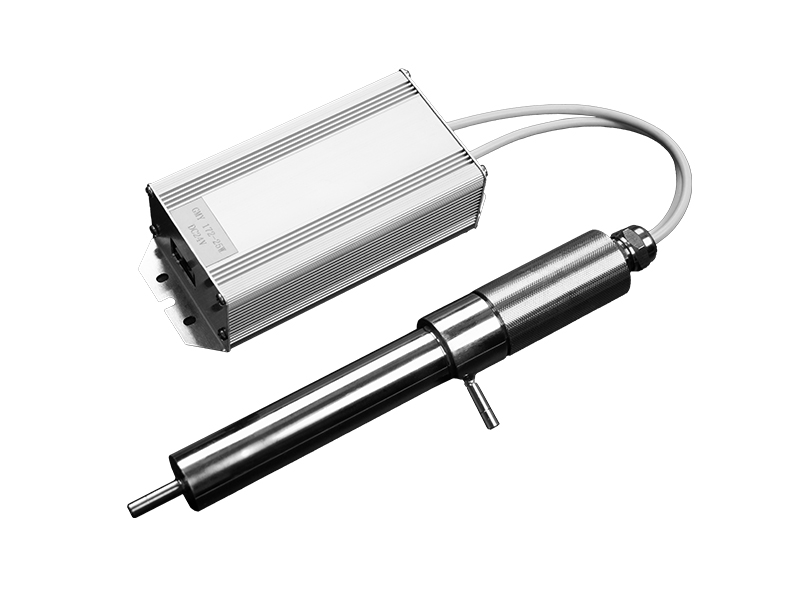
Photochemical cleaning and surface activation represent the two dominant surface modification applications for this technology. Both processes exploit the high-energy photons to alter surface chemistry without thermal damage.
Photochemical Cleaning
You will find photochemical cleaning essential for removing organic contaminants from precision substrates. Silicon wafers, glass panels, and optical components arrive with photoresist residues, oils, and fingerprints that compromise performance. The 172nm Excimer Lamp breaks carbon-carbon and carbon-hydrogen bonds directly. Simultaneously, the radiation generates ozone from ambient oxygen. This ozone oxidizes the fragmented residues into volatile carbon dioxide and water vapor. The process leaves no liquid waste and requires no drying step.
The efficiency figures impress. One documented case shows a 99.9% removal rate for organic matter on silicon wafer surfaces within three minutes. A customer case confirms the same 99.9% removal rate for wafer pretreatment. These results explain why display panel production, touch panel production, and wafer processing increasingly rely on this dry method.
The removal rate of organic matter on the silicon wafer surface reaches 99.9%, and the processing time is only 3 minutes.
Consider the comparison with traditional wet cleaning. A world-leading semiconductor manufacturer replaced chemical solvent-based cleaning with excimer technology. The old method left chemical residues and raised environmental concerns. After adoption, the company achieved residue-free cleaning, improved efficiency by 30%, and reduced waste liquid treatment costs. The deep ultraviolet photons at 7.2 eV break most chemical bonds rapidly. Unlike wet chemistry, no secondary contamination occurs from cleaning agents themselves.
Surface Activation for Adhesion
Surface activation transforms inert polymer surfaces into chemically reactive interfaces. The 172nm radiation creates hydroxyl and carbonyl groups on polymer chains. These functional groups increase surface energy and wettability dramatically. You need this treatment before applying inks, coatings, or adhesives to low-energy plastics.
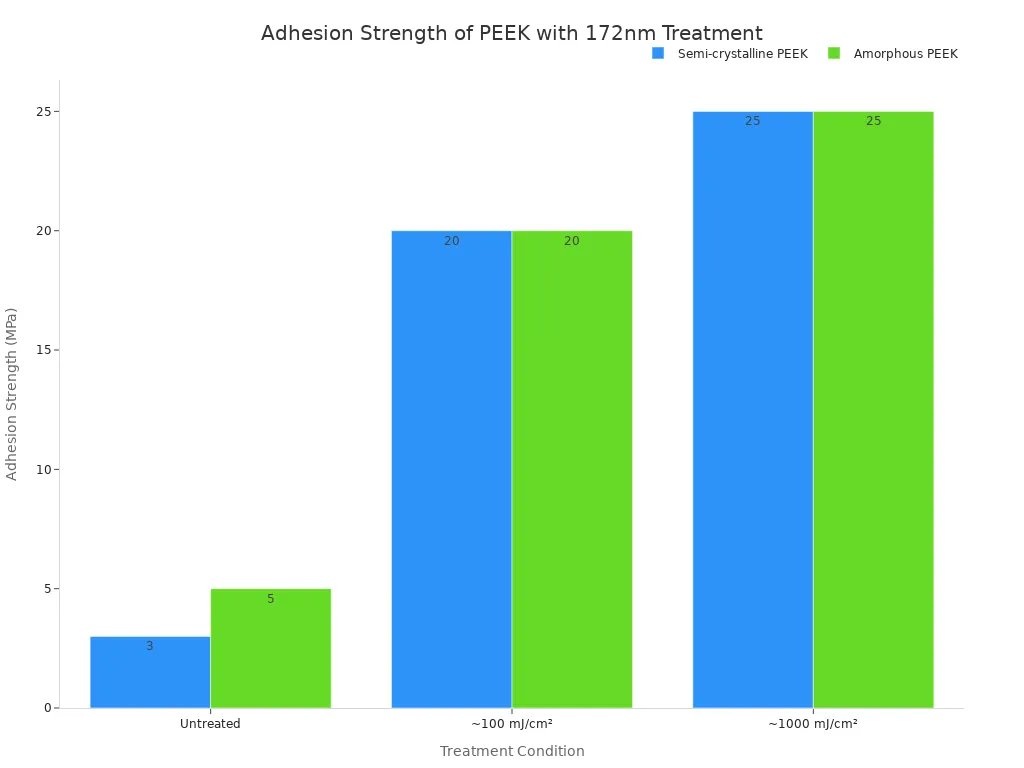
The quantitative improvements demonstrate the value. Semi-crystalline PEEK shows adhesion strength rising from 3 MPa untreated to approximately 20 MPa at 100 mJ/cm² and 25 MPa at 1000 mJ/cm². Amorphous PEEK improves from 5 MPa to the same elevated levels.
|
Material |
Untreated Adhesion Strength (MPa) |
Adhesion Strength at ~100 mJ/cm² (MPa) |
Adhesion Strength at ~1000 mJ/cm² (MPa) |
|---|---|---|---|
|
Semi-crystalline PEEK |
3 |
~20 |
~25 |
|
Amorphous PEEK |
5 |
~20 |
~25 |
Excimer lamps emitting 172nm increase wettability and surface energy across glass, metals, and polymers. This activation serves as an alternative to plasma and corona treatments. PCB manufacturing relies on this step for reliable solder mask adhesion. Automotive part assembly uses it for bonding plastic components. The process integrates seamlessly into "light cleaning" and "light curing" production lines.
Industries adopting this technology include PVC flooring, decorative films, fibreboards, laminates, wood panels, and automotive plastic parts. The primary industrial uses for surface modification continue expanding as manufacturers discover new applications.
Advanced Oxidation and Curing Applications
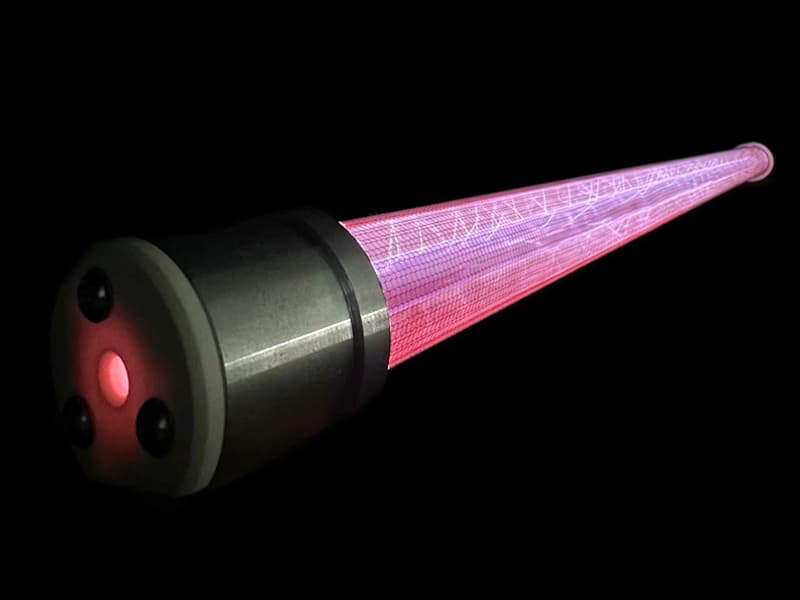
Beyond surface modification, the 172nm excimer source drives two critical processes: total organic carbon (TOC) degradation in ultrapure water and low-temperature UV curing. Both applications leverage the same high-energy photons to achieve results impossible with conventional technologies.
TOC Degradation in Water
You need ultrapure water with TOC levels below parts-per-billion for semiconductor fabrication and pharmaceutical production. Traditional UV lamps cannot break down stubborn organic compounds effectively. The 172nm wavelength delivers 7.2 eV per photon, enabling advanced oxidation that degrades organic impurities into harmless carbon dioxide and water.
The oxidation potential of this process far exceeds that of conventional UV oxidation methods. You eliminate chemical additives entirely, avoiding secondary contamination. A 172nm Excimer Module integrates directly into water treatment loops, providing continuous TOC reduction without consumable chemicals. Semiconductor fabs rely on this technology to maintain water purity specifications that directly impact device yield. Pharmaceutical manufacturers use the same approach to meet stringent regulatory requirements for water-for-injection systems.
The process operates continuously and requires no regeneration cycles. You monitor TOC levels in real-time and adjust flow rates accordingly. Unlike chemical oxidation methods, this approach leaves no residual byproducts that could compromise downstream processes.
Low-Temperature UV Curing
You face a fundamental challenge when curing adhesives and coatings on heat-sensitive substrates. Conventional mercury lamps emit significant infrared radiation, raising substrate temperatures and causing warping, discoloration, or dimensional changes. The 172nm excimer source solves this problem elegantly.
Unlike conventional medium-pressure mercury UV lamps, excimer lamps emit no IR radiation, resulting in no heat impact on substrates and eliminating the need for elaborate cooling or ozone ventilation.
The thermal stability of excimer technology extends beyond the emission spectrum:
-
The surface of an excimer lamp's quartz tube does not get hot (unlike mercury vapor lamps).
-
Most excimer lamps run with little-to-no cooling, and are instant ON/OFF with no warm-up or cool-down cycles, confirming thermal stability.
You can cure specialized photopolymer resins at ambient temperatures on plastics, paper, and other delicate materials. High-speed roll-to-roll processes benefit enormously, as you eliminate cooling stations and reduce floor space requirements. The instant ON/OFF capability allows precise energy dosing, preventing over-curing or substrate damage.
Precision applications demand this level of control. When you bond optical components or cure protective coatings on flexible electronics, thermal management becomes critical. A reputable Excimer Lamp Manufacturer will specify the exact energy density required for your resin system, ensuring consistent cure depth without thermal stress.
These advanced oxidation and curing applications represent the second major category of primary industrial uses for this versatile light source. The combination of chemical-free oxidation and cold curing expands manufacturing possibilities across multiple sectors.
The four primary industrial uses—photochemical cleaning, surface activation, TOC degradation, and low-temperature curing—make the 172nm Excimer Lamp essential. You gain precision, cold processing, and chemical-free operation. Industry reports project 10% annual growth. As quality demands rise, adoption of the 172nm Excimer Module will expand. A trusted Excimer Lamp Manufacturer enables next-generation innovation.
FAQ
Does 172nm excimer treatment damage heat-sensitive substrates?
No. The 172nm Excimer Lamp emits no infrared radiation, so substrates remain at ambient temperature. You can process plastics, paper, and flexible electronics without warping, discoloration, or dimensional changes.
How does 172nm surface activation compare to plasma treatment?
Both methods increase surface energy, but excimer offers distinct advantages. You get uniform treatment without vacuum chambers, no electrode contamination, and instant ON/OFF capability. The process integrates inline more easily than plasma systems.
Can you retrofit existing production lines with excimer technology?
Yes. A 172nm Excimer Module mounts directly into current conveyor systems or water treatment loops. You need minimal floor space, no cooling infrastructure, and no chemical storage. Most manufacturers complete integration within days, not weeks.